
Why Did Raghav Chadha Join BJP? Full Reason, Strategy & Political Impact
Category: Uncategorized
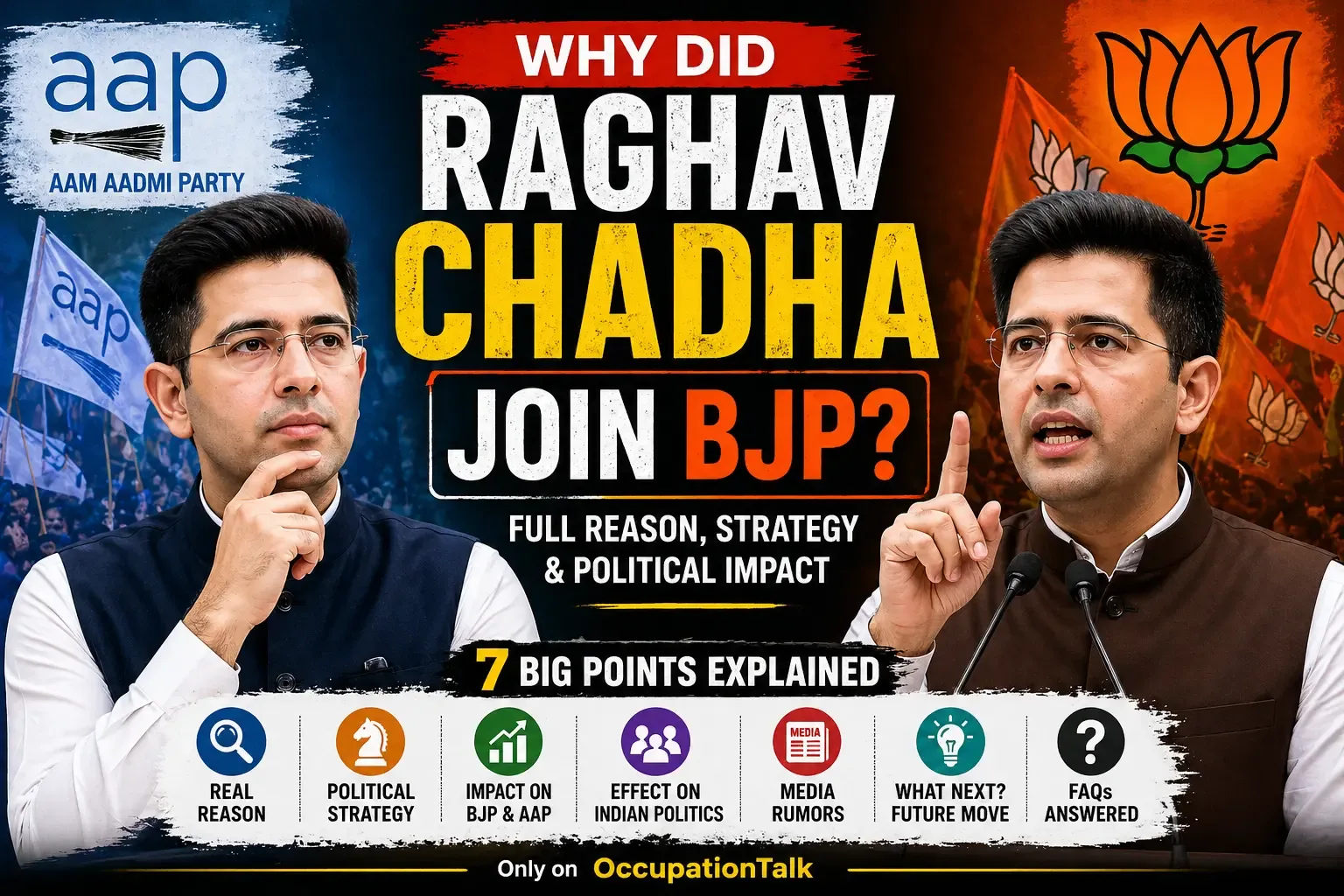
In the fast-moving world of Indian politics, things change overnight. But few stories have grabbed as many headlines recently as the talk surrounding the popular Aam Aadmi Party (AAP) leader, Raghav Chadha. For years, Raghav was seen as the "poster boy" of AAP—a young, articulate, and highly educated face who helped the party win big in Punjab. However, recent events have turned the spotlight on a massive shift.
If you have been scrolling through your news feed lately, you’ve probably seen the headline: “Raghav Chadha joins BJP.” This news has left supporters, critics, and neutral observers wondering what actually happened. Is it a rumor, or has a major political "earthquake" really taken place?
At OccupationTalk, we believe in looking at the human side of these professional shifts. Politics, after all, is a career choice for many, and every big move comes with a reason. Today, we will break down the full story, the strategy behind it, and what it means for India’s political future.
Reality Check: Did He Actually Join BJP?
Before we dive into the "why," let’s look at the "if." For a long time, there were only whispers and rumors about Raghav Chadha moving to the Bharatiya Janata Party (BJP). However, recent reports from April 2024 suggest that this is no longer just a rumor.
According to multiple news outlets and public announcements, Raghav Chadha, along with six other Rajya Sabha MPs from the Aam Aadmi Party, has reportedly taken the step to join the BJP. This move is being described as a "merger" of sorts to avoid the strict Anti-Defection Law, which usually punishes leaders for switching parties unless a two-thirds majority of the group moves together.
While some official formalities might still be in process, the public stance taken by Raghav and his colleagues—citing a drift in AAP's original values—makes it clear that the bridge has been crossed. At OccupationTalk, we often see professionals leave organizations when they feel the "company culture" has changed, and it seems the same logic applies to this high-profile political exit.
Possible Reasons Behind the Big Shift
Why would a founding member of AAP, a man who was once the right hand of Arvind Kejriwal, decide to switch sides? Here are the primary factors that experts believe triggered this move:
1. Internal Conflict and Being "Sidelined"
Politics is often about being heard. For several months, there were signs that Raghav Chadha was being sidelined within his own party. He was recently removed from his position as the Deputy Leader of AAP in the Rajya Sabha. For a young, ambitious leader, being demoted can be a hard pill to swallow. When a person feels their growth is blocked, they naturally look for other opportunities where their skills are valued.
2. Disagreement with Party Ideology
In his recent statements, Raghav Chadha mentioned that the AAP he helped build has strayed from its founding principles. Originally, the party was born out of an anti-corruption movement. Raghav alleged that over time, the party became more about "personal gain" and "corrupt practices" rather than serving the people. Whether this is the complete truth or a tactical statement, it serves as a strong reason for a public exit.
3. Career Growth and National Ambitions
The BJP is currently the largest and most powerful political machine in India. For a young leader like Raghav, who has a background as a Chartered Accountant and a strong grip on finance and policy, the BJP offers a much larger stage. Rumors suggest he could even be considered for a Union Minister role or a significant position in the central leadership. From a career perspective, moving from a regional power like AAP to a national giant like BJP is a major promotion.
4. Pressure and Legal Battles
We cannot ignore the climate of Indian politics today. Many AAP leaders have been facing intense scrutiny from agencies like the ED and CBI. Critics of the BJP often call this "Washing Machine Politics," where leaders join the ruling party to get relief from legal pressure. While there is no direct evidence that this was Raghav's primary motive, it is a point that many political analysts are discussing.
Political Analysis: Impact on BJP and AAP
This move isn't just about one person; it's about the numbers and the image of the parties involved.
Impact on AAP: A Massive Setback
Losing Raghav Chadha is a "double blow" for AAP. First, they lose a brilliant communicator who could defend the party on national television in perfect English and Hindi. Second, the loss of seven Rajya Sabha MPs significantly weakens their voice in Parliament. It creates a "trust deficit" among the volunteers who looked up to Raghav as the future of the party.
Impact on BJP: A Fresh Face in Punjab
The BJP has traditionally struggled to find a strong footing in Punjab. By bringing in Raghav Chadha—who was a key architect of AAP’s Punjab win—the BJP gains a leader who understands the state’s pulse. He brings youth, a clean-shaven professional image, and a connect with the modern Indian voter that the BJP is always looking to expand.
The Strategy: The "Two-Thirds" Move
The most interesting part of this news is the strategy. If Raghav Chadha had joined the BJP alone, he would have likely lost his seat in the Rajya Sabha due to the Anti-Defection Law. However, by bringing six other MPs with him (making it 7 out of 10 AAP MPs), they meet the legal requirement to "merge" or move without being disqualified. This shows a very calculated and well-planned professional move, much like the strategic shifts we discuss at OccupationTalk.
Impact on Indian Politics
This event signals a major shift in how opposition parties might function in the future. It shows that even the most "loyal" and "ideological" leaders can be swayed or forced to change paths when internal dynamics fail. It also strengthens the BJP’s narrative that they are the only "stable" choice for leaders who want to work for the "national interest."
For the average voter, it can be confusing. It raises the question: "If the founding members are leaving, who can we trust?" This could lead to a more polarized environment or, conversely, a more consolidated political landscape where the BJP becomes even more dominant.
Conclusion: The Clear Truth
In conclusion, the news that Raghav Chadha joins BJP appears to be a reality born out of internal rifts, career ambitions, and a shift in political alignment. While AAP calls it a "betrayal" and a result of "Operation Lotus," Raghav and his supporters see it as a necessary step to stay true to their personal values and serve the country better.
Politics is a tough "occupation," and as we often say at OccupationTalk, sometimes you have to change your desk to keep doing the work you believe in. Only time will tell if this move helps Raghav reach new heights or if he gets lost in the massive ranks of the BJP. One thing is for sure—the political map of India has just changed significantly.
? Frequently Asked Questions
Q. Is Raghav Chadha officially in the BJP now?
Q. Why did Raghav Chadha leave AAP?
Q. Will Raghav Chadha lose his Rajya Sabha seat?
Q. What is the "Raghav Chadha BJP news" trending about?
Q. Who else joined the BJP with him?
Other Blogs You May Like

Rajaji National Park: A Hidden Wildlife Gem Near Rishikesh
Discover Rajaji National Park near Rishikesh — a lesser-known reserve with tigers, elephants, leopards, and 5 unique safari zones to explore.
Read more →
Water Damage Restoration in Chicago: Complete Homeowner's Guide to Fast Recovery
Learn how water damage restoration in Chicago works, common causes, restoration steps, costs, insurance tips, and how to protect your property.
Read more →
Why Tech Troubleshooting Guides Are Essential for Everyday Smartphone Users
Smartphones are an important part of daily life, but common issues like app crashes, internet problems, storage warnings, and network errors can create frustration. This article explains why practical troubleshooting guides are helpful for Android and iPhone users and how step-by-step fixes can solve everyday smartphone problems easily.
Read more →