
Is World War 3 Possible? Understanding the Risk of US–Iran Conflict
Category: Global News
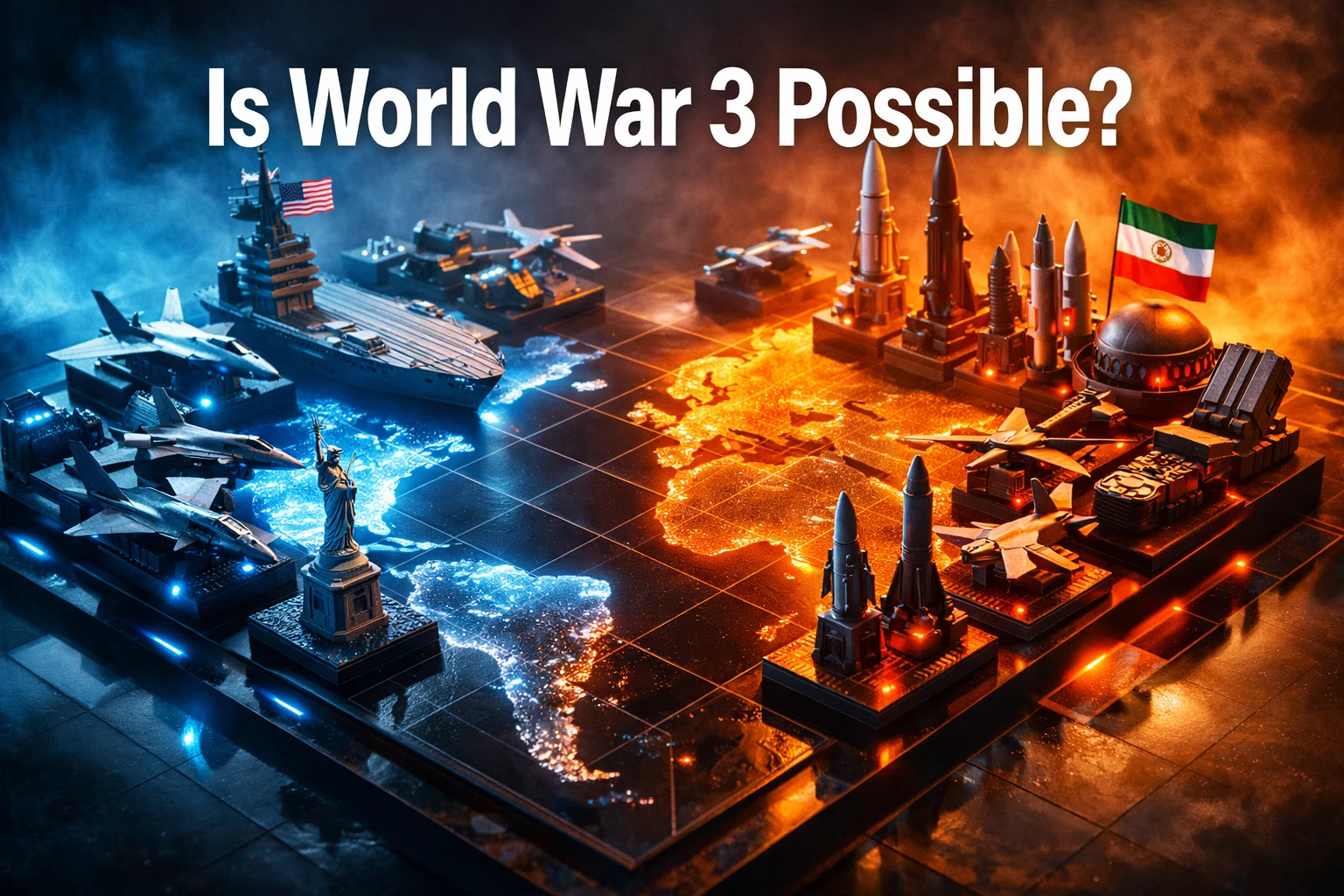
Have you noticed how every time you check the news lately, the headlines seem a bit more intense? One day it’s a new set of sanctions, the next it’s a drone strike or a heated speech from a world leader. It’s hard not to feel a little bit of anxiety creeping in.
With the current tensions between the United States and Iran reaching a boiling point, people are naturally starting to wonder if we are headed toward something much bigger. You’ve probably seen the term World War 3 trending on social media, often accompanied by maps and scary-sounding predictions. But is that really where we are headed, or is there more to the story?
Background of US–Iran conflict
To understand the risk, we have to look at why these two countries are at odds in the first place. It isn’t just about one event; it’s a decades-long history of “it’s complicated.”
Ever since the 1979 revolution in Iran, the relationship has been defined by deep mistrust. On one side, the U.S. is concerned about Iran’s nuclear program and its influence over various groups in the Middle East. On the other side, Iran feels that the U.S. is constantly trying to interfere with its government and economy.
Recently, things have become even more strained. We see “maximum pressure” campaigns, seized oil tankers, and back-and-forth military strikes. It feels like a high-stakes game of chess where neither side wants to back down.
Why people are talking about World War 3 risk
So, why are people suddenly using the phrase World War 3 again? The main reason is how connected our world is today. If a conflict breaks out in the Middle East, it rarely stays there.
Iran has friends, and the U.S. has many allies. People worry that if a direct war starts, other powerful countries like Russia or China might feel forced to pick a side to protect their own interests. When big powers start lining up against each other, that’s when the global fear begins.
However, it’s important to remember that most of these countries actually want to avoid a massive war. Large-scale fighting is incredibly expensive, destroys trade, and puts everyone’s security at risk. Usually, the loud threats we hear are a form of occupationtalk—the kind of political posturing where leaders use tough language to occupy the news cycle without actually intending to launch an invasion.
What could actually happen
If we move away from the “end of the world” scenarios, what does a realistic conflict look like? Most experts think it wouldn’t be a repeat of the massive world wars of the 1940s. Instead, it would likely be a “gray zone” war.
- Cyberattacks: Instead of dropping bombs, countries might try to shut down each other’s power grids or banking systems.
- Proxy Battles: Fighting through smaller groups in other countries rather than meeting face-to-face on a battlefield.
- Targeted Strikes: Small, precise military actions against specific facilities rather than a full-scale invasion.
While this is still very serious and dangerous, it is a different level of conflict than the total global collapse people often fear.
Impact on common people
Even if a full-scale war doesn’t happen, the “rumors of war” still affect our daily lives. You don’t have to be a soldier to feel the impact of a US–Iran conflict.
The biggest and most immediate impact is usually at the gas pump. Much of the world’s oil travels through the Strait of Hormuz, a narrow waterway right off the coast of Iran. If that area becomes a war zone, oil prices skyrocket.
When gas gets expensive, the price of everything else—like groceries and shipping—goes up too. Beyond that, the uncertainty can hurt the stock market, which affects retirement savings and jobs. It’s a reminder of how a problem on the other side of the planet can end up affecting your wallet.
Conclusion
So, is a massive global war inevitable? In short: no. While the risks are real and the tensions are higher than they’ve been in years, there is still a lot of room for diplomacy.
Many people feel that we are on the edge, but history shows that even the bitterest enemies often find a way to step back from the cliff. Both the U.S. and Iran know that a total war would be a disaster for their people and their futures.
It’s okay to be concerned—it shows you’re paying attention—but it’s also helpful to realize that scary headlines are often just that. For now, the world is watching, waiting, and hopefully, talking.
Other Blogs You May Like

Rajaji National Park: A Hidden Wildlife Gem Near Rishikesh
Discover Rajaji National Park near Rishikesh — a lesser-known reserve with tigers, elephants, leopards, and 5 unique safari zones to explore.
Read more →
Water Damage Restoration in Chicago: Complete Homeowner's Guide to Fast Recovery
Learn how water damage restoration in Chicago works, common causes, restoration steps, costs, insurance tips, and how to protect your property.
Read more →
Why Tech Troubleshooting Guides Are Essential for Everyday Smartphone Users
Smartphones are an important part of daily life, but common issues like app crashes, internet problems, storage warnings, and network errors can create frustration. This article explains why practical troubleshooting guides are helpful for Android and iPhone users and how step-by-step fixes can solve everyday smartphone problems easily.
Read more →